“The mountain always wins… unless you respect it.”

When people hear that Sani Stagger is almost entirely downhill, they usually smile and say,
“Well that sounds easy!”
Those people have never run Sani Pass.
Over the past five years I’ve experienced just about everything this race can throw at me.
Some years I was fit. Some years I was wildly optimistic. Some years life simply got in the way. But every run, Sani taught me something new.
And every year reinforced one simple lesson:
Running downhill is a strength event disguised as a running race.
2021 – We Thought We Were Ready
Before our first Sani Stagger we did everything “right.”
We drove up and ran from the South African border all the way down to the hotel where the finish line is.
Even then we were shocked.
It was so much steeper than we’d imagined.
So we kept preparing.
More training runs.
Two half marathons.
Lots of excitement.
Race day arrived and everything clicked.
It was one of the most enjoyable races I’ve ever run.
To this day, Sani 2021 still holds my fastest ever 10 km on Strava and my second-fastest half marathon.
I thought I’d figured Sani out.
I hadn’t.

2022 & 2023 – Life Had Other Plans
Then…
One of us got knocked up.
Suddenly there was a tiny human in the picture.
Long runs were replaced with nappies, sleepless nights and figuring out this whole parenting thing.
Sani had to wait.
Sometimes the best training decision is accepting that life happens.
2024 – You Can’t Fake Preparation
This was the year confidence wrote a cheque that my legs couldn’t cash.
If I’m honest…
I don’t think I’d put my running shoes on for over six weeks before race day.
Life with a toddler turned out to be far more demanding than I’d ever imagined.
I convinced myself I’d be okay.
Spoiler alert…
I wasn’t.
About halfway down my ITB decided it had officially resigned.
I ended up surviving thanks to multiple anti-inflammatories and painkillers generously donated by complete strangers on the mountain.
Whoever you are…
Thank you.
By the second half of the race I had developed a very scientific pacing strategy.
Run 50 steps.
Walk 50 steps.
Repeat.
Not because it was part of my race plan…
Because it was literally all my ITB would allow.
For the first time ever, Em and I didn’t even cross the finish line together.
That hurt almost as much as my leg.
2025 – We Finally Learned…
…or so we thought.
This year we actually started training properly.
Long runs.
Downhill sessions.
Consistency.
Everything was pointing towards personal bests.
Then life happened again.
Em broke her wrist…
…while chasing her cat upstairs.
You honestly couldn’t make this stuff up.
A month before Sani I was offered the opportunity to travel to the Netherlands with a hockey tour.
It was a once-in-a-lifetime opportunity.
It also meant every spare cent went towards that trip instead of race preparation.
By race day…
We were undercooked.
Again.
The funniest part?
We climbed onto the shuttle bus…
…and discovered we were sitting next to the very same strangers who had kept me moving the previous year by sharing their anti-inflammatories.
Clearly Sani friendships are forever.
Unfortunately…
The mountain hadn’t become any easier.
This year my knees were screaming.
Em’s ankles weren’t much happier.
We staggered over the finish line.
Then discovered the real meaning of Sani Stagger.
By the time we’d walked back to the car…
We genuinely staggered.
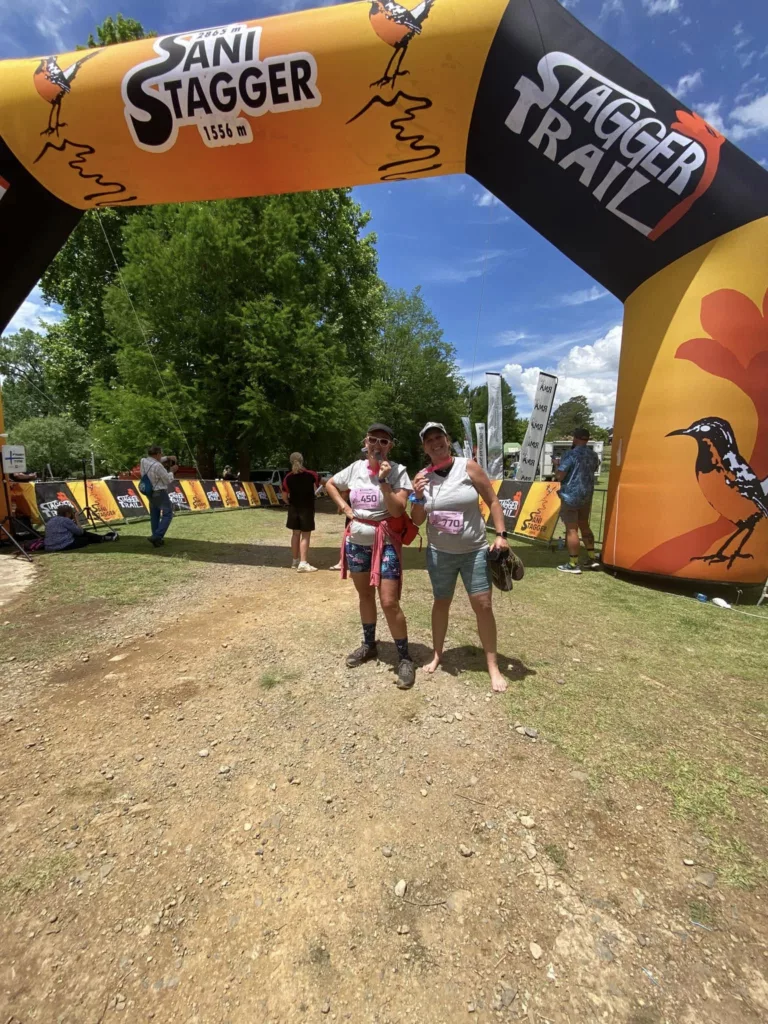
2026 – This Time We’re Doing Things Differently
Race day is fast approaching.
Poor Em has somehow managed to break a bone in her foot…
Yes.
Four months before race day.
Apparently we’re determined to keep the annual injury tradition alive.
I can’t speak for how her preparation will go.
But I know mine is going to look very different.
Yes…
I’m running.
But this year running isn’t the only focus.
This year I’m building a body that can actually handle 21.1 kilometres of downhill punishment.
That means strengthening:
- Glutes
- Quads
- Hips
- Ankles
- Knees
- Core
- Balance
- Single-leg stability
Because after five attempts I’ve finally realised something.
The runners who enjoy Sani the most aren’t necessarily the fittest.
They’re the strongest.
The Biggest Lesson Sani Has Taught Me
Running gets you to the start line.
Strength gets you to the finish line.
Every downhill step is a controlled braking action.
Your quads absorb the impact.
Your glutes stabilise your hips.
Your ankles fight to stay balanced.
Your knees take thousands of repetitive loads.
Eventually something gives.
If you’re lucky…
It’s just your ego.
If you’re unlucky…
It’s your ITB.
Or your knees.
Or your ankles.
Why I Built a Sani Stagger Strength Programme
This is exactly why I created my 12-Week Sani Stagger Strength Programme.
Not because I think strength training replaces running.
It doesn’t.
It complements it.
The programme focuses specifically on preparing your body for the unique demands of Sani Pass by improving:
- Quad endurance
- Glute strength
- Hip stability
- Core control
- Ankle strength
- Knee resilience
- Single-leg balance
- Downhill durability
It’s the programme I wish I’d followed before my first Sani.
And it’s exactly what I’m using to prepare for this year’s race.
My Goal for 2026
This year I’m not chasing a personal best.
I’m chasing something better.
I want to finish the race strong.
I want to enjoy every kilometre.
I want to get back to the car without looking like I’ve aged 30 years.
Most importantly…
I’d like there to be a little less stagger after Sani.
If you’re joining me on the mountain this year…
I can’t wait to see you there.
Just don’t underestimate the downhill.
It always wins.
Unless you prepare for it.